
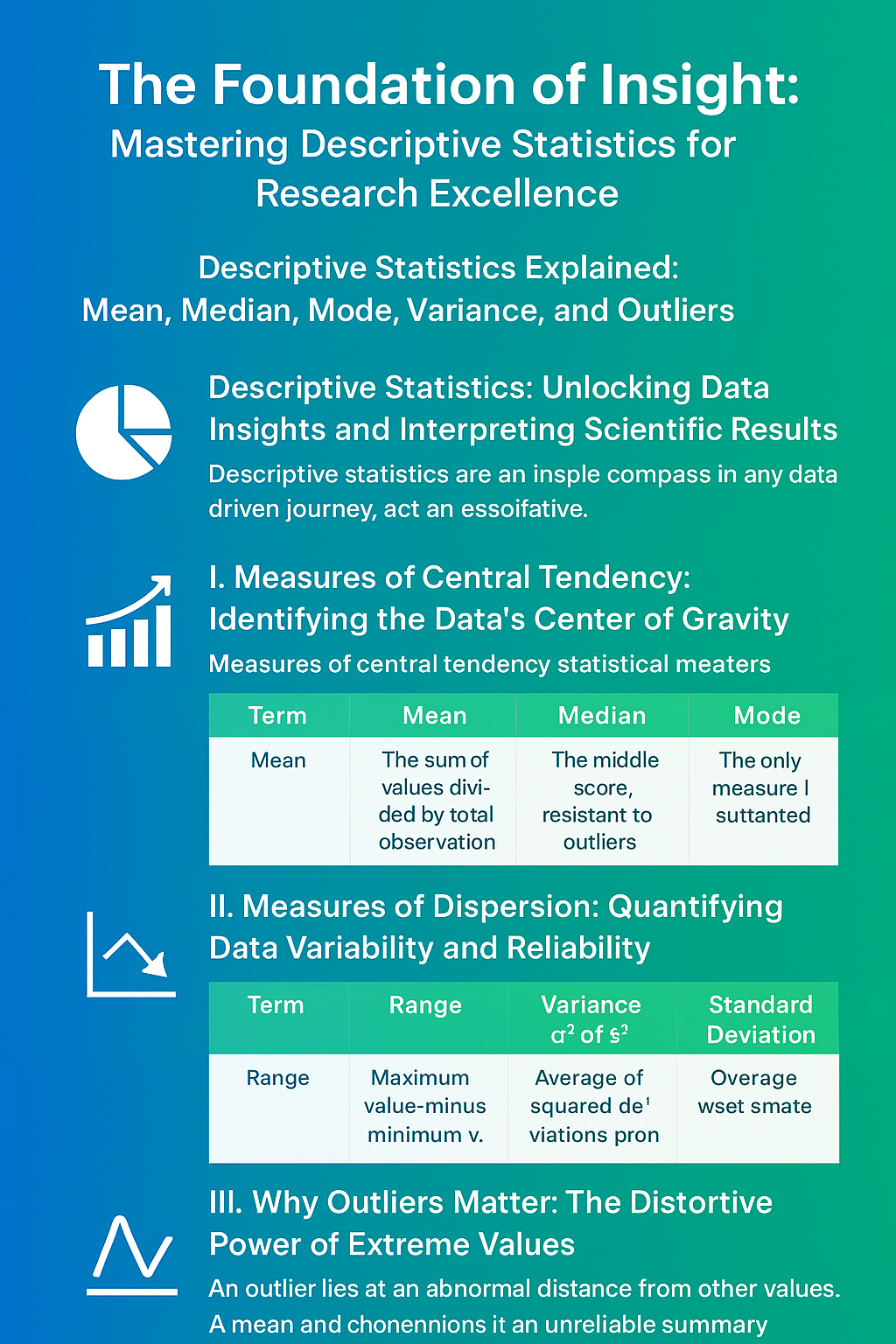

Descriptive Statistics Explained: Mean, Median, Mode, Variance, and Outliers | AIC Blog
Meta Description: Learn the essential descriptive statistics—central tendency (Mean, Median, Mode) and dispersion (Variance, St. Dev, Range). Understand how outliers impact data analysis. Perfect for students and researchers in Bioinformatics and data science.
🧮 Descriptive Statistics: Unlocking Data Insights and Interpreting Scientific Results
Descriptive statistics serve as the initial compass in any data-driven journey, whether you're analyzing molecular biology data, assessing the efficacy of academic writing tools, or performing complex bioinformatics techniques. They provide simple, yet profound, summaries about the fundamental characteristics of a dataset, transforming raw numbers into digestible information. This mastery is crucial for effective statistical data analysis, a core area of focus for AI Concepts Limited.
I. Measures of Central Tendency: Identifying the Data’s Center of Gravity
Measures of central tendency are statistical metrics that pinpoint the central or typical value within a set of data. They give us a single, representative value that aims to encapsulate the entire distribution.
| Term | Detailed Explanation & Usage in Research |
| Mean (Arithmetic Average) | The sum of all observed values divided by the total number of observations (N). It's highly sensitive to every value in the set. Best Use: With data that is symmetrically distributed (normally distributed). |
| Median | The exact middle score when a dataset is arranged in order. Advantage: Its primary strength is its resistance to outliers, making it the preferred measure for skewed distributions (e.g., income data). |
| Mode | The observation that occurs with the greatest frequency. Primary Use: It is the only measure suitable for nominal (categorical) data, such as finding the most common reagent used in a molecular biology lab. |
Export to Sheets
Example Dataset: Student Test Scores
Consider a dataset of computational skills test scores: 5,7,7,8,10 (representing N=5 scores).
- Mean: 5(5+7+7+8+10)=537=7.4
- Median: The ordered list is 5,7,7,8,10. The middle value is 7.
- Mode: The score 7 appears most frequently.
II. Measures of Dispersion: Quantifying Data Variability and Reliability
Measures of dispersion (or variability) tell us how spread out the data points are. A low measure suggests the data is tightly clustered, indicating high precision; a high dispersion implies the data is spread across a broad range.
| Term | What it tells us about data spread and consistency |
| Range | The simplest measure: Maximum Value - Minimum Value. Provides a quick sense of the total span but is highly sensitive to outliers. |
| Variance (σ2 or s2) | The average of the squared deviations from the Mean. It magnifies the influence of observations far from the mean but is hard to interpret directly because the units are squared. |
| Standard Deviation (σ or s) | The square root of the Variance. This is the gold standard for measuring spread. It's brought back to the original units of the data. Key Interpretation: A smaller standard deviation signifies that the data points are reliable and tightly clustered around the mean. |
Export to Sheets
III. Why Outliers Matter: The Distortive Power of Extreme Values
An outlier is an observation that lies an abnormal distance from other values. Outliers have a dramatic and potentially misleading effect on the mean, making the average an unreliable summary of the dataset.
Example: Outlier Impact on Mean vs. Median
Using our original scores (5,7,7,8,10; Mean = 7.4; Median = 7), let's introduce an extreme outlier—a score of 50: New Dataset: 5,7,7,8,10,50 (total of N=6 scores).
- New Mean: 6(5+7+7+8+10+50)=687=14.5
- New Median: The middle two values are 7 and 8. 2(7+8)=7.5
Conclusion: The single outlier (50) dragged the mean from 7.4 up to 14.5, a highly inaccurate representation of the typical score. The median, which barely shifted (7 to 7.5), proves its utility as a robust measure when data distribution is asymmetrical.
IV. Summarizing Data: The Essential Role of Visualization
The ultimate goal of descriptive statistics is communication. Transforming numerical summaries into visual aids is essential for conveying scientific results clearly.
- Tables: Best for presenting precise numerical details and for detailed referencing.
- Charts and Graphs: Provide an immediate, intuitive understanding of the data's shape and distribution.
- Histograms show frequency distribution.
- Box-and-Whisker Plots offer a concise visualization of the median, quartiles, and—crucially—the outliers, an indispensable tool in data quality checks.
Effective data visualization is a critical component of the scientific process, enabling clear analysis and interpretation of the data insights generated by powerful scientific research tools and statistical data analysis tools recommended by AI Concepts Limited.
Further Reading & Tools:
Want to apply these concepts to your research? Explore our recommendations for molecular biology laboratory tools and academic writing tools to help you collect, analyze, and communicate your findings effectively.